
Buying a Distressed Business: Ten Tips for Entrepreneurs

Buying a Distressed Business: Ten Tips for Entrepreneurs
By Scott Edward Walker
Strategic Law Partners, LLP
Now that the “easy-credit” party has presumably ended, there will likely be extraordinary opportunities for entrepreneurs to buy distressed (i.e., financially-troubled) businesses at bargain prices. Buying a distressed business, however, is tricky stuff and raises a host of significant risks and potential problems that are not typically found in the acquisition of a healthy, solvent business. Below are ten tips for entrepreneurs who are looking to get into the distressed M&A game, which relate to two different contexts: (i) prior to (or absent) a distressed target’s Chapter 11 filing — i.e., the non-bankruptcy context; and (ii) after a distressed target’s Chapter 11 filing — i.e., the bankruptcy context. As discussed below, it is generally advisable to purchase a distressed business after the target’s Chapter 11 filing pursuant to Section 363 of the Bankruptcy Code (a “Section 363 Sale”) due to its speed, benefits and flexibility.
Non-Bankruptcy Context
1. Do Your Diligence. A comprehensive due-diligence investigation is a fundamental buy-side component of any acquisition, but it is particularly important in connection with the acquisition of a distressed business due to, among other things, the likelihood of limited (or a lack of) recourse post-closing. Needless to say, a rigorous analysis of why the business is distressed is critical — e.g., Is the business over-burdened with debt? Are there any significant liabilities such as an adverse judgment or product liability claims? Has the business lost key management? Are the target’s problems merely related to poor execution? Only after such an analysis has been completed can the entrepreneur and his/her transaction team strategize to develop an effective game plan in connection with the acquisition. Indeed, it may very well be the case that the buyer’s only practical course of action is an acquisition in the bankruptcy context.
2. Buy Assets, Not Stock (Equity). Generally speaking, it is usually advantageous for an acquiror of a private company to purchase assets, not equity, of the target for two principal reasons: (i) it will obtain a stepped-up tax basis in the acquired assets; and (ii) it will minimize the assumption of any unwanted liabilities. If the private company is severely distressed, however, there may not be tax benefits to an asset deal; it is nevertheless clearly the most prudent structure from a liability/risk perspective due to the greater likelihood of undisclosed/unknown liabilities of the target relating to the stresses of the circumstances, including potential tax liabilities, claims/lawsuits accruing pre-closing and perhaps fraudulent activities. (The target, of course, will often push back and insist that the buyer take the entire company — warts and all.) The bottom line is that every deal is different and must be structured and negotiated with the assistance of competent counsel, including tax counsel.
3. Take Steps To Protect Against a Fraudulent Transfer Challenge. If assets from a distressed target are purchased prior to a Chapter 11 filing, a significant risk the entrepreneur buyer faces is a subsequent fraudulent transfer challenge. Under federal law, state law and/or the Bankruptcy Code, the sale can be avoided (i.e., set aside) upon a showing by dissatisfied creditors or by a bankruptcy trustee subsequent to a bankruptcy filing that there was “actual” fraud (i.e., the sale was actually intended to hinder, delay or defraud creditors) or, more likely, “constructive” fraud (i.e., the sale was made for less than fair consideration or reasonably equivalent value and the target was insolvent at the time of, or rendered insolvent by, the sale). Indeed, Section 544 of the Bankruptcy Code permits a bankruptcy trustee to utilize applicable state law to avoid such transfers for “reach-back” periods of six years or more. To minimize this risk, a buyer must do two things: (i) build the best possible record that “fair consideration” or “reasonably equivalent value” was paid (e.g., by obtaining a fairness opinion from a reputable investment bank); and (ii) require that (A) the sale proceeds stay with (or be used for the benefit of) the target and not be distributed to the target’s stockholders and/or (B) adequate arrangements are made to pay-off the target’s creditors.
4. Sign and Close Simultaneously. Another significant risk the entrepreneur buyer faces when acquiring a distressed business in the non-bankruptcy context is the possibility of the target’s Chapter 11 filing after the purchase agreement has been executed, but prior to closing. In such event, the target would have the right to “reject” the purchase agreement, and the buyer would merely have an unsecured, pre-petition claim against the target for its damages (often worth pennies on the dollar). Conversely, the target would also have the right to “assume” the purchase agreement thereby locking the buyer into a deal that, perhaps, may not look so good after weeks/months of the deterioration of the target’s business. (Not to mention the possibility of a significant time delay in waiting for the target’s decision of rejection/assumption.) The best way to eliminate this risk is to sign and close the acquisition simultaneously.
5. “Hold-back” or Escrow a Significant Portion of the Purchase Price. If the distressed target files for bankruptcy after the closing of the acquisition of its assets, the buyer’s claim for a purchase price adjustment and/or indemnification under the purchase agreement will be treated as an unsecured, pre-petition claim (again, often worth pennies on the dollar). Indeed, certain indemnification claims may be disallowed if they are contingent at the end of the Chapter 11 case. Absent a guarantee from a creditworthy affiliate or stockholder of the target (which will obviously be difficult to obtain), the best way a buyer can protect against this risk is to hold-back or escrow a significant portion of the purchase price. An escrow/holdback is often used in connection with the acquisition of a healthy private company (typically 10-15% of the purchase price); however, if the company is distressed, the buyer should consider a greater amount.
Bankruptcy Context
6. A Section 363 Sale is Usually the Way to Go. The purchase of assets of a Chapter 11 debtor may be consummated either as a Section 363 Sale or as part of the debtor’s overall plan of reorganization. A Section 363 Sale is the more common method because it is faster and cheaper (i.e., it avoids the plan confirmation process – with its complex disclosure and voting procedures) and therefore minimizes the risk of a decline in enterprise value and/or a shortage of working capital. From the buyer’s perspective, a Section 363 Sale is often more attractive than a non-bankruptcy acquisition for a number of significant reasons, including: (i) in most cases, the bankruptcy court will approve the sale of the assets “free and clear” of all liens and liabilities (other than those liabilities that the buyer expressly agrees to assume and, arguably, certain “successor” liabilities such as environmental and product liabilities claims); (ii) the approval of the bankruptcy court should bar any subsequent fraudulent conveyance challenge (as discussed above); (iii) the buyer will be able to cherry-pick assets and contracts (e.g., through the debtor’s assumption/rejection rights discussed above) in ways not possible in the non-bankruptcy context and assumed contracts will be “cleansed” of non-assignability or change-of-control provisions (except for certain contracts such as personal-services contracts and certain intellectual-property licenses); and (iv) State shareholder-approval laws and bulk- transfer laws generally do not apply to a Section 363 Sale.
7. It May Pay To Be the Stalking Horse. A Section 363 Sale is subject to bankruptcy court approval after notice to interested parties and a hearing. To ensure that the debtor has obtained the “highest and best” price for its assets, an auction will usually be conducted under the supervision of the bankruptcy court. Accordingly, the threshold question for a prospective buyer is whether it should play the role of the “stalking horse” bidder (i.e., be the initial party to execute a purchase agreement with the debtor) — or just wait to see the final sale terms approved by the bankruptcy court and then decide whether to make a higher bid (assuming it has such an opportunity). There are a number of advantages to being the stalking horse, including: (i) more opportunity to conduct an adequate due-diligence investigation; (ii) the ability to set the threshold price and terms of the sale; and (iii) the ability to negotiate certain deal protections and bid procedures, as discussed below. The major risk to being the stalking horse, of course, is bidding too high — i.e., locking into a deal that may not look so good at the time of the auction.
8. Negotiate With All of the Relevant Constituencies. In the non-bankruptcy context, a buyer generally negotiates solely with the distressed target’s management and need not deal with its creditors (except where the buyer is seeking amendments to debt documents or waivers, etc.). In a Section 363 Sale context, however, there are a number of different constituencies — often with disparate interests — with which the buyer must deal, including perhaps secured creditors (e.g., first-lien and second-lien holders), unsecured creditors, equity holders (e.g., preferred and common stockholders), bondholders, landlords, indenture trustees, etc. Indeed, it is imperative that the buyer understand the debtor’s capital structure and the dynamics of the various pieces and then keep all of the relevant constituencies “on board” throughout the negotiation process. To be sure, a Section 363 Sale will generally require the support of secured creditors unless the sale proceeds are adequate to pay them in full. If there are first-lien holders and second-lien holders, and the first-lien holders will be paid in full, but the second-lien holders will not, the second-lien holders may be able to block the sale. Moreover, equity holders and/or unsecured creditors will often oppose a Section 363 Sale if their interests have not been adequately addressed (e.g., if only secured creditors are being made whole by the sale) and they think a plan of reorganization would be more beneficial to them — though a Section 363 Sale may generally be approved over their objection.
9. Focus on the Bidding Procedures in the Purchase Agreement. If the buyer is willing to be the stalking horse, it must bear in mind the context of the transaction and the competitive environment discussed above (i.e., the likelihood of a subsequent auction). Indeed, the purchase agreement that the stalking horse executes must be approved by the bankruptcy court and will serve as the bid document against which other parties will submit their proposals. Accordingly, it makes strategic sense to keep the agreement as simple as possible and for the buyer to rely on its due diligence and the order of the bankruptcy court for protection rather than comprehensive representations and warranties and indemnification provisions (which will significantly discount its bid). The most effective use of the stalking horse’s leverage is in connection with the negotiation of bidding procedures, including: (i) a bid deadline and an auction date, (ii) qualified bidder criteria provisions (e.g., no financing conditions), (iii) overbid requirements and matching rights, (iv) a termination fee and expense reimbursement provisions and (v) auction rules.
10. A “Pre-Pack” May Be a Good Alternative. Time is often the buyer’s biggest (and least predictable) risk in connection with purchasing distressed assets in the bankruptcy context. The debtor’s filing may, for example, trigger protracted negotiations among the various constituencies, unexpected claims, litigation, etc. Accordingly, “prepackaged” Chapter 11 plans (“Pre-Packs”) — which may include a Section 363 Sale — are becoming more prevalent (particularly in light of the increased costs and the difficulty of existing management to control the bankruptcy process under the Bankruptcy Abuse Prevention and Consumer Protection Act of 2005, the new bankruptcy law that went into effect in October 2005). Indeed, where a company has a sound business model, but is overburdened by debt, a Pre-Pack may be particularly appealing to avoid the risks of purchasing distressed assets in the non-bankruptcy context (discussed above), coupled with the lower approval thresholds of Chapter 11.
Scott Edward Walker is a former big-firm New York corporate lawyer, with 14+ years of sophisticated M&A and securities experience. Mr. Walker is currently Of Counsel to Strategic Law Partners, LLP, a boutique corporate law firm in downtown Los Angeles specializing in mergers and acquisitions and venture capital financing. Please note that the foregoing article has been provided by Mr. Walker solely for informational purposes and does not constitute (and should not be construed as) legal advice in any respect. Mr. Walker expressly disclaims all liability in respect of any actions taken or not taken based on any contents of the article. Copyright © 2007 Scott Edward Walker. All Rights Reserved.
We hope you found this article about “Buying a Distressed Business: Ten Tips for Entrepreneurs” helpful. If you have questions or need expert tax or family office advice that’s refreshingly objective (we never sell investments), please contact us or visit our Family office page or website www.GROCO.com.
To receive our free newsletter, contact us here.
Subscribe our YouTube Channel for more updates.

Alan Olsen, is the Host of the American Dreams Show and the Managing Partner of GROCO.com. GROCO is a premier family office and tax advisory firm located in the San Francisco Bay area serving clients all over the world.
Alan L. Olsen, CPA, Wikipedia Bio

GROCO.com is a proud sponsor of The American Dreams Show.
The American Dreams show was the brainchild of Alan Olsen, CPA, MBA. It was originally created to fill a specific need; often inexperienced entrepreneurs lacked basic information about raising capital and how to successfully start a business.
Alan sincerely wanted to respond to the many requests from aspiring entrepreneurs asking for the information and introductions they needed. But he had to find a way to help in which his venture capital clients and friends would not mind.
The American Dreams show became the solution, first as a radio show and now with YouTube videos as well. Always respectful of interview guest’s time, he’s able to give access to individuals information and inspiration previously inaccessible to the first-time entrepreneurs who need it most.
They can listen to venture capitalists and successful business people explain first-hand, how they got to where they are, how to start a company, how to overcome challenges, how they see the future evolving, opportunities, work-life balance and so much more..
American Dreams discusses many topics from some of the world’s most successful individuals about their secrets to life’s success. Topics from guest have included:
Creating purpose in life / Building a foundation for their life / Solving problems / Finding fulfillment through philanthropy and service / Becoming self-reliant / Enhancing effective leadership / Balancing family and work…

MyPaths.com (Also sponsored by GROCO) provides free access to content and world-class entrepreneurs, influencers and thought leaders’ personal success stories. To help you find your path in life to true, sustainable success & happiness. It’s mission statement:
In an increasingly complex and difficult world, we hope to help you find your personal path in life and build a strong foundation by learning how others found success and happiness. True and sustainable success and happiness are different for each one of us but possible, often despite significant challenges.
Our mission at MyPaths.com is to provide resources and firsthand accounts of how others found their paths in life, so you can do the same.

Mastering Business Growth with Howard Shore
Howard Shore, Founder and CEO of Activate Group Inc. discusses managing, even mastering, business growth and the challenges growing quickly can present on Alan Olsen‘s American Dreams Show. Transcript: Alan Olsen Welcome to American Dreams. My guest today is Howard Shore. Howard, welcome to today’s show. Howard Shore Alan, thank you for having me. Alan…

Prosperity and Self-Reliance Zealot Steve Alder
From North America to Ghana, Africa, Steve Alder, President of Ensign Global College (www.ensign.edu.gh), sits down to discuss how a professor helps to build global prosperity and self-reliance on Alan Olsen‘s American Dreams Show. Transcript: Alan Olsen Welcome to American Dreams I’m visiting here today with Steve Alder. Steve, welcome to today’s program. Steve Alder Thank…
Steve Young on Building an Epic Family Legacy
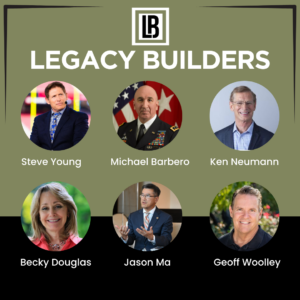
Retired 49r Steve Young Discusses Building a Family Legacy at the Legacy Builders Event on May 15, 2024 As GROCO celebrates three decades of excellence in family office tax and advisory services, we have developed the Legacy Builders to stands as a testament to the firm’s enduring vision: to transform wealth into a powerful tool…

Leadership, Duty, Honor & Country With Lt. Gen. Mike Barbero
Retired US Army Lieutenant General, Michael D. Barbero, discusses leadership, service, duty, honor, and country on Alan Olsen‘s American Dreams Show. Transcript: Alan Olsen Hi, this is Alan Olsen and welcome to American Dreams. My guest today is General Michael Barbero. General, welcome to today’s show. Mike Barbero Thanks, Alan, how are you? Thanks for having me. It’s…