
The Bypass Trust: Using Disclaimers to Manage Large IRA Balances
The Bypass IRA Trust:
California CPA, December 2001Trying to fund a bypass trust can be problematic if clients only have a residence and a large retirement plan as their major assets. On the surface, a residence isn’t a good asset for a bypass trust for two reasons: A trust doesn’t qualify for the exclusion under IRC Sec. 121; and–probably most importantly–the surviving spouse generally wants to own the family residence. Likewise, an IRA (or qualified plan) isn’t the best choice for a bypass trust because of income taxes imposed on the retirement benefits. When the spouse is named as the beneficiary of the retirement plan and all other assets are in a revocable trust, the first spouse’s unified credit exemption can go unused. This fact pattern may be a problem now but will be more prevalent when the unified credit exemption equivalent amount reaches $1 million and higher. Beginning next year, we will be faced with funding larger funding bypass trusts. At that dollar level, avoiding the use of retirement assets will be almost impossible.
Required Minimum Distributions
The IRS issued proposed regulations in January 2001 to assist taxpayers in determining Required Minimum Distributions (RMD). A major change in these new proposals is that the beneficiary of an IRA or qualified retirement plan is now determined as of Dec. 31 of the year after the plan participant or IRA owner passes away. The preamble to the new proposed regulations mentions that the timing of the beneficiary determination will allow for the use of disclaimers.
Often disclaimers are used to take advantage of marital or charitable deductions or to correct some situations in the estate plan. A qualified disclaimer is not considered a gift from the disclaimant to the recipient of the disclaimed assets.
A qualified disclaimer is defined in IRC Sec. 2518 as an irrevocable and unqualified refusal to accept an interest in the property, but only if:
(a) such refusal is in writing;
(b) such writing is received by the transferor of the interest, his or her legal representative, or the holder of the legal title to the property to which the interest relates not later than the date, which is nine months after the later of (i) the day on which the transfer creating the interest in such person is made, or (ii) the day on which such person attains age 21;
(c) such person has not accepted the interest or any of its benefits; and
(d) as a result of such refusal, the interest passes without any direction on the part of the person making the disclaimer and passes either (i) to the spouse of the decedent, or (ii) to a person other than the person making the disclaimer.
The plan administrator or IRA custodian is the one to whom a qualifying disclaimer of retirement benefits should be directed. The disclaimed benefits will pass to the person who would receive them if the original beneficiary had predeceased. Naming contingent beneficiaries allows for disclaimers.
Contingent Beneficiary
The original beneficiary cannot choose where the disclaimed property will go, so a contingent beneficiary must be in place to receive the benefits. In PLR 9630034, an IRA disclaimer was used to fully fund an exemption can an IRA be in a trust. This strategy worked because the trust was a contingent beneficiary. A numerical example may make PLR 9630034 easier to understand.
Let’s assume that our clients, Dave and Susan, owned the following assets:
Residence $300,000
IRA (Dave) 1,700,000
Liquid Assets 200,000
Total Assets 2,200,000
It’s a community property state and Dave had been receiving required minimum distributions from the IRA with Susan as beneficiary. The contingent beneficiary is the revocable ira in trust.
Dave dies in 1995. After the date of death and before Dec. 31, 1995, Susan rolls her community property interest in Dave’s IRA to a new IRA (Susan).
Susan then proposes to disclaim a fraction of the remaining IRA (Dave). The fraction is the amount needed to fully fund the bypass trust at $600,000 (the 1995 amount). Dave’s community property interest in the other assets was $250,000, so an additional $350,000 was needed.
It was important that Susan disclaimed a fraction of the IRA rather than a dollar amount. If Susan were to disclaim $350,000, that amount of Dave’s IRA would be immediately taxable for income tax purposes. Using a fractional disclaimer, the IRA is not taxable until distributed.
Once Susan’s IRA was augmented by the amount not disclaimed ($850,000 less $350,000); Susan’s IRA was split into four separate IRAs, with each of her children as a beneficiary of one of the new IRAs. The new IRAs were established and beneficiaries named by Dec. 31, 1996. The IRS ruled that the disclaimer was effective and that dividing Dave’s IRA in this way did not trigger any income.
Income Tax Considerations
For income tax purposes, the bypass trust would be the beneficiary of Dave’s IRA. The trust qualifies as a designated beneficiary, so Susan’s life is used to measure RMDs. Each year the RMD is determined based on the value of Dave’s IRA and Susan’s age. The distribution is then transferred from Dave’s IRA to the bypass trust.
When the trust receives the distribution, it looks to the trust provisions or local law to determine how the distribution is taxed. If the bypass trust distributes all income to Susan, she will be taxed on whatever portion of the distribution is treated as income.
When the trust agreement is silent, the income portion of a retirement distribution is determined by state law. In 2001, 10 percent of a retirement distribution is treated as income under the California Uniform Principal and Income Act.
This means that 10 percent of the RMD would be distributed to Susan and she would be taxed on it. The 90 percent remains within the trust and is subject to high federal income tax rates. If the bypass trust accumulates income, the entire RMD will be taxable to the trust.
These high-income taxes are the price that is paid to fully fund the bypass trust in California. Since we often focus on income tax savings when working with trusts, this will be a sea change for many of us.
Changing Times
Until now, many clients have had sufficient assets so that using the IRA for trust funding was unnecessary. Next year when the unified exemption reaches $1 million, it will become more common to tap into these inconvenient assets when funding a bypass trust.
As the unified exemption spirals ever higher, our clients will be faced with many choices. They may choose to leave the bypass amount underfunded, but it’s too early to tell if this is the best strategy.
The estate tax repeal will make income tax planning more important than the avoidance of estate tax, and as a result, using an IRA to fund the bypass trust could become extremely unattractive. No matter what happens to the estate tax, clients with large IRA balances will need our help to solve these estate planning issues and knowing how to use disclaimers will make us better able to meet the challenge.
Subscribe our YouTube Channel for more updates.
Mastering Business Growth with Howard Shore
Howard Shore, Founder and CEO of Activate Group Inc. discusses managing, even mastering, business growth and the challenges growing quickly can present on Alan Olsen‘s American Dreams Show. Transcript: Alan Olsen Welcome to American Dreams. My guest today is Howard Shore. Howard, welcome to today’s show. Howard Shore Alan, thank you for having me. Alan…
Prosperity and Self-Reliance Zealot Steve Alder
From North America to Ghana, Africa, Steve Alder, President of Ensign Global College (www.ensign.edu.gh), sits down to discuss how a professor helps to build global prosperity and self-reliance on Alan Olsen‘s American Dreams Show. Transcript: Alan Olsen Welcome to American Dreams I’m visiting here today with Steve Alder. Steve, welcome to today’s program. Steve Alder Thank…
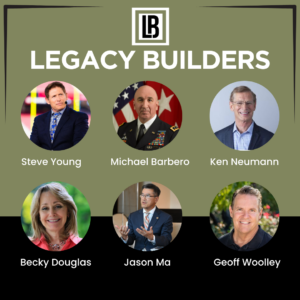
Steve Young on Building an Epic Family Legacy
Retired 49r Steve Young Discusses Building a Family Legacy at the Legacy Builders Event on May 15, 2024 As GROCO celebrates three decades of excellence in family office tax and advisory services, we have developed the Legacy Builders to stands as a testament to the firm’s enduring vision: to transform wealth into a powerful tool…
Leadership, Duty, Honor & Country With Lt. Gen. Mike Barbero
Retired US Army Lieutenant General, Michael D. Barbero, discusses leadership, service, duty, honor, and country on Alan Olsen‘s American Dreams Show. Transcript: Alan Olsen Hi, this is Alan Olsen and welcome to American Dreams. My guest today is General Michael Barbero. General, welcome to today’s show. Mike Barbero Thanks, Alan, how are you? Thanks for having me. It’s…